- Article
Grid2050: Keeping the lights on
Automation solutions for next-generation electric grids
Flip a switch, and the lights come on. It feels effortless, almost magical. But behind that simple gesture lies one of the most complex machines ever built: the electric grid.
Electricity powers nearly everything around us. Traditionally, a small number of large power plants generated it and sent it through a network of wires to homes, hospitals, factories, and cities. This interconnected web is the electric grid. To understand how it works, imagine a container filled almost to the brim with water.
At the top is a large faucet representing power plants. Water flowing in is electricity generation. Along the sides, countless small holes leak water. They represent consumption: your phone charging, an elevator moving, a factory running. The holes constantly change size. A quiet night shrinks them. A hot afternoon makes them widen.
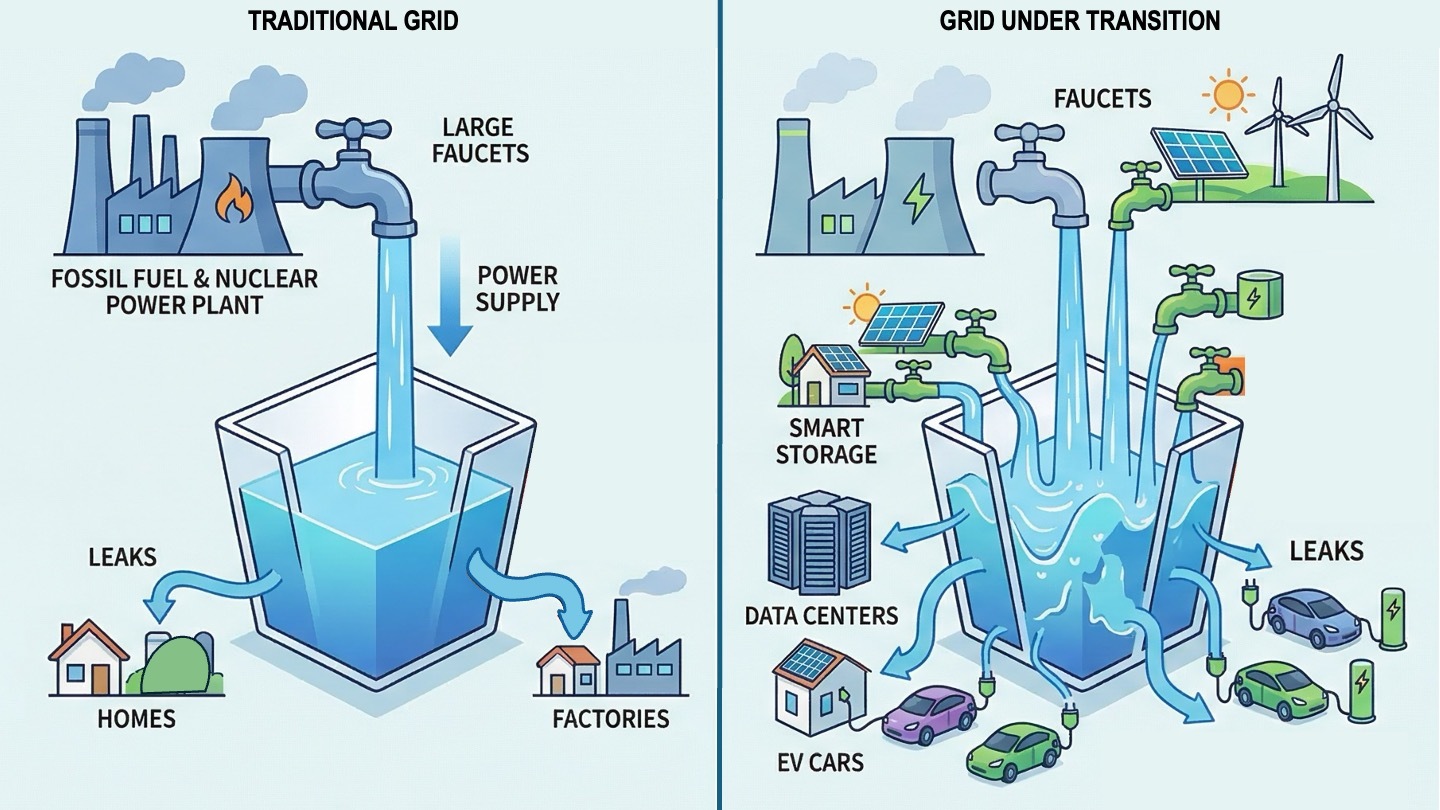
The grid stays stable only if the water level remains steady. Supply must match demand at every moment. Too much and the container overflows. Too little and the level drops. Either way, the result is a blackout.
Grid operators cannot control when people use electricity. They can only adjust the faucet, minute by minute, to keep the system in balance. Now the faucet is multiplying. Millions of small generators—from rooftop solar panels to backyard wind turbines—feed the container. Most cannot be controlled, and their output rises and falls with the weather. At the same time, the leaks are shifting faster as data centres surge and electric vehicles plug in.
This energy transition is good news for the climate. But it also makes balancing the container harder. For now, grid operators still rely on adjusting the large faucet to compensate for everything else. As fossil-fuel plants retire, that stabilising capacity will decline. A new challenge emerges: coordinating millions of small faucets and smoothing out ever-changing leaks.
Small faucets must move together, and the leaks must become more predictable. Behind the scenes, this means developing digital architectures and control algorithms that can communicate, decide, and act in real time, balancing generation and demand across thousands of devices.
At Grid2050, an initiative of NCCR Automation, we are building these capabilities in practice. We design methods with researchers, test them with system operators on real-world infrastructure, and work with policymakers to enable deployment at scale.
Our goal is to keep the water level steady, so that the lights do not go out even as the system becomes cleaner, more complex, and more dynamic. This work supports Switzerland’s vision of a net-zero energy system under Energy Strategy 2050.